Showing posts with label work. Show all posts

Thursday, May 10, 2012

work and worship

A friend sent me a comment, via email, to a previous post about integrating body life (church) and work.  He rightly points out that some of my observations need to taken further, in order for the (possibly impressionistic, possibly individualistic) connections to be made more strongly. I agree. The comments were helpful. The commenter has thought deeply along these lines for a long time. I'll quote him below, and respond in turn.

But first, a picture comes to mind.

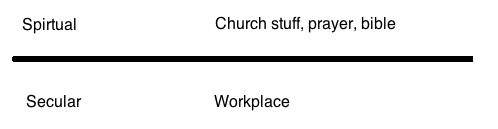
Lets imagine a Christian world view  (well, a world view i think many christians have, at some level) -  a two level view of the world.


 And as soon as we draw it, we know thats too simple - we should make the line dashed and all that.  We know God is creator, everything is His, etc. In fact, its not a Christian world view at all - its entirely incorrect.  

But nevertheless, in operative terms, i think we often tend to that dualism. We tolerate it and often revert to it.

Here is how the commenter went: Quoted my post  first (italics below). Then commented (in blue).


"In several churches, i've noticed that in addition to the pastoral staff, it is the volunteer group (eg the occasional RE teachers) who are cited- and i think its right that they are supported like this, as they try to get to the point of sharing their faith. But should the complexity and heavy demand of the other roles be invisible - seeing as they are also bringing the redemptive leaven of the kingdom in other ways? Or do they just have a job - a 'secular job' at that? "

This observation is a true one. My belief is though that until others can actually show the vital connections between faith/work as a necessary whole connection with the Gospel, then the current divisions on sacred/secular will remain.

In spite of what you say about the "slipstream of faith" being able to carry one into these connections at your workplace, I think that on the whole they are hard to make and even harder to verbalize within the body times.

I don't think being "transformed by the renewing of your mind" is an automatic thing just by being connected to the engine of faith.
When confronting the existing deep seated cultural 'norms' of our days, I think it biblical to name and confront the 'idols of our times' which infect and drive each cultural sphere and this surely must be done with great prayer, ongoing reflection and consultation within groups of believers who work in similar contexts(ie teachers together, technicians together) together by those listening to what the Spirit says and then finding together strategies with which to respond.
My contention is that this ought to be the focus of body life. This is our spiritual worship as Paul contends.
Our body life would surely explode with excitement and holy awe and fear and rejoicing as we share how God is moving through us to release the creation from its groaning despair. 

I was going to say more, but i can't now recall what it was - but the comments in blue speak to me  - we attended a workshop on theology of work, and i think a vision of naming some of these in the body time could help - not that  i know how it could be done. Simply starting with naming each ones role and work from time to time would help i suppose - ie doing interviews of what people do.

The theology of work website that accompanied the seminar would also be a useful study tool. If i had time i'd like to run a series of studies based on that site. Listen to the president of the project explain it. Not the most photogenic chap, but thats hardly the point!
http://www.theologyofwork.com/pages.asp?pageid=101815

or as Bill Johnson said of work, in a sermon from around that time. :

Work is supposed to be a tool that is used – a musical instrument in a sense, that is used– that we use in giving worship to God. When work is robbed from someone – worship, the tool of worship, is robbed from their life, a unique expression of worship. The whole Jewish culture looked at work, labour, as a way of giving expression of worship to God. And I feel like we’re supposed to rise as church family toward the devourer who would steal the privilege of labour from everyone who is supposed to be able to work. I feel like its supposed matter.


Tuesday, February 21, 2012

lasers and rainbows (3) - metaphors for faith in the workplace

this is also an early post that i reverted to a draft status for a couple of years as being a bit lopsided. trimmed it a bit - hopefully sings better now

in part 1 of this little debrief i introduced the idea of lasers and rainbows to describe tight or more distributed faith cultures, and then in part 2 looked at how some of that played out in family and devotional issues

This post unpacks how some of this has been in workplace - which has been a very real issue for me. Indeed the mismatch and tension here - as experienced across several styles of church (and types of work) - probably generated much of the rainbow/laser reflection in the first place ... i guess you could call it an inadequate conception or theology of work, which led to the need to thrash out some working idea of how the more 'laser like' focus needed to be diffracted into this domain - moving away from a centre to the particular incarnate details of what one might be uncovering in the context of a life, even perhaps, a calling

So as well as rainbows and lasers, there are half a dozen other metaphors that i've found myself using to think of church and faith (in the workplace in particular) etc...

i'll start with two related ones

(i) church can be like an engine of faith and prayer - and i have at times said to myself I will drove that engine beyond the church culture, and empower whatever vehicle i'm called to drive down whatever unique road seems to be the path of life i've been placed in
(ii) i will tap into the slipstream of dynamic faith here, 'spiritually, but not culturally'"

This all sounds quite individualistic, but its in reaction to a tendency for church to imply, perhaps not intentionally, that the main sphere of activity is in its programs and official ministries

so the common theme here in possibly moving beyond 'God in a box'

That is, i value my ongoing church based experience of God as valid and real, but have needed to integrate into other dimensions of life; notably the workplace. Even though I see the deposit of faith and teaching as precious - priceless - and significant, as well as the faith and relationships that are inculcated, i have still needed to sketch out some thinking that released me from a restrictive assumption that easily develops. That is, "the more significant places and times and agendas must therefore be located in connection with church or in its orbit of its programs". Without diminishing them, they are not the whole story, or perhaps even the main story, for most of us.

Perhaps we need a way to change that orbiting metaphor - to see that all is truly in the orbit of the God who made all.  Jesus at the centre of the ornate complexities of creation-  not the gathered church and its activities - although He is there in a different and more present sense. Seeing the earth go around the sun, rather than being a fixed point at the center, made much sense of the heavenly data - and lead to a simpler and cleaner approach to what was already observed.  Shifting that cultural center - away from Christendom with church at the center - might be like the Copernican revolution - the earth is still there, but we have re-thought what is actually happening at sunset and sunrise - or in this case,  between those times. Similarly here we rethink the daily round of work - shifting some of the centrality out of the church. And find that while losing that fixed point of is less intuitive on one level, it explains a lot of other events much more effectively.

Thus in my case, I will be a better teacher, for example, in Catholic or state schools, if i happen to be there. I will be more faithful in the execution of complex tasks, bring more vision and clarity here, have better endurance here; be better at the inevitable relational challenges, explore particular dimensions and complexities of educative thinking; be more effective in planning and strategy; tune into God's words and impression in more diverse and complex settings than the default church culture seemed to imagine.

These examples of the principle of empowering a vehicle that seems largely off the church radar; while nevertheless drawing on an engine of faith discovered there, could no doubt be multiplied endlessly in other lives and and settings, through other personalities and careers etc.

And perhaps something about this actually fullfills the Ephesians 1 mandate of the church to be 'all in all'

A related and similar image, "i will tap into the slipstream of dynamic faith here, 'spiritually, but not culturally'" - is simply giving oneself the necessary permission to follow the dimensions of God's calling away from the assumption that all is in church and its programs- to take the release of an empowered life, and  run across cultural spaces.

That is, by tuning into the genuine faith of meetings etc, and dynamism of worship, the impartation of meaning in teaching, there is renewal and healing and vision; yet the outworking is well beyond the walls of the church and its religious markers, and expressed in entirely other cultural spaces. To take my education example again, the church might see the local school as a place to run an 'outreach program'; which is no doubt a good thing, but extension of church program, as good as it may be, might not really coincide with what other Christians might be doing at the school. So they might perhaps attend the little breakfast club as token of good will - and one certainly hopes it will reach some kids - but it is possible that the volunteers will not really understand the issues the full time teacher faces there; one is not necessarily a good lens for what the other is doing; for what  the maths teacher is trying to do in rethinking the original constructivist heritage of  educational IT, for example - similarly in every other subject area and cultural dimension of the school - and these explorations also reflect creation mandates - to explore and name the content under redemptive leaven, and work the garden. (In passing, a Christian pedagogy that just wants to teach known facts and content, and not invite some exploration, seems to me to misrepresent the original biblical - as in Genesis - mandates which are restored in Christ- even as we still wrestle with thorns).

Again the point of this is not my own story, but that we all are called to spheres like this, and its not always visible or celebrated in a gathered community. Does this matter? Well, can we celebrate the diversity of what the people of God are called to? As an example, which Christians will be upheld as having a ministry, supported in prayer meetings for evangelistic success etc?

In several churches, i've noticed that in addition to the pastoral staff, it is the volunteer group (eg the occasional RE teachers) who are cited- and i think its right that they are supported like this, as they try to get to the point of sharing their faith. But should the complexity and heavy demand of the other roles be invisible - seeing as they are also bringing the redemptive leaven of the kingdom in other ways? Or do they just have a job - a 'secular job' at that?

If we have this problem with teaching - which must be one of the most obvious (and in Christian circles, still quite valued) roles in the community - what of other roles...

We're dimly aware that health professionals and doctors and parents and business people 'do good' : not really seeing the fullness of a call worked out there

For more obscure examples, i have felt creative solutions come in technical areas ... in both software and science - have felt pieces drop into place in timely ways - one can sense at times the guidance over key pieces - even though many hours or days of precursor work or subsequent refinement is needed,- the slipstream of faith helps, although  operating beyond the thinking of a church service where it might have been incubated.

Thus the instinctive rubric "i will tap into the slipstream of dynamic faith here, 'spiritually, but not culturally'" (formulated in a particularly intense church : but applicable in many)

Having said this, a clerical response might say, of course; faith is meant to be leaven in your life; bringing vision and integrity to whatever it is you do ....

agreed ... but perhaps more could be done to open up the stories of this in church communities; the models of what it means to follow God tend to be silent on such things ... to default either to silence, or more linear ideas of evangelism. Perhaps something more of the diversity and glory of what God has called us all to would be celebrated and empowered.  Silence does tend to privilege entire realms and model the 'ministry' as the fulltime church worker. Dubious theology i think, inheriting a dualism that struggles to include the fullness of what God has made, the very good spoken over creation, the redemptive agenda that reaches to it all.

It might seem churlish or selfish to expand all this - but the risk is we can limit significant roles and ideas of calling and God's activity to a small subset of people or a small subset of activity

I'm not anti church, anti institution - quite the contrary really - i like the laser events -  just have needed to question the assumption that easily sets in - 'what happens here (church based activity) is of most significance' ; when perhaps its just the clearest encoding of a message that needs to live in wider spheres.

Lastly, these are homespun reflections and intuitions, not necessarily well formed statements of philosophy, let alone theology. But if they are an inadequate or impressionistic method for mapping the territory, i should perhaps plead that 20 years of regular church attendance has rarely strayed into discussing how the connections should be conceived.  We sat in leadership in a church once, one of four lay couples, meeting regularly, and even then we never managed to table the stories and challenges and callings of our full time work, much less model that integration to others; such is the gravitational pull of that centre.   A small group is somewhat more agile perhaps. One wants the laser of focussed worship and teaching when together, of course...   yet the rainbow also beckons over wider realms.

Friday, January 6, 2012

follow the cloud - of work and church

-->
Brief outline of some of the ways God has led me in the workplace  -  loosely in chronological order. 

Many more mini stories in here i can't tell of course –-(I jump ahead to working in the catholic school as I write that  – stories of working with secondary kids and the many blessings and learnings of all that for me as well   - could probably draw some good vignettes of that  -  but I won’t go there in detail – except to say I was grateful for the years there - i grew as much as they i think.)

Anyway – back to more linear order– I bounced round uni for a while, without much focus and in an increasing state of disrepair or despair along lonely paths – yet searching out and entering into blessing of faith along the way –   being called in from those fragmenting places to God's wisdom and way is another way of saying that – or saying the same thing from another angle - and I gradually started bouncing round less. More to be said there, but that will do in outline.  (this hints at some more)

And then started work at a hi-tech manufacturer – fell on my feet with a holiday job that got extended ; R&D in spectrophotometry ; working with some brilliant people, and seeing the reality of a multidisciplinary team tackling really tricky issues. Work morphed a few times –all jobs do, I find – and was blessed to be assigned to the most talented engineer in to the place – crazy and disorganized but brilliant.  The intractable deal breaking problem on the new project -  that had already taken 100+ person years -  had ended up with him, and I was his offsider while we chased it down – great job and l loved that too. 

Then moved to an analytical lab, on the basis of that background expertise with these devices. Was less interesting and more routine just driving the things – but i think taught me how to stand under various pressures; dealing with endless short term and complex deadlines etc; and building faith.  A word flashed into me at the time – I have made you a tester of metals (Jer 6:27) and that is what these things did -  dissolved materials in acid and sprayed into a plasma as hot as the surface of the sun, and read the spectral lines – revealing the trace impurities that the eye couldn’t see - how much arsenic in the water or lead in the soil.  There were many rich ways of God speaking to me at work at the time; on a particular wavelength as it were, as though  i were an atom and he the massive Sun - yet could pick out just the right spectral frequency to reach me. 

Also programmed up systems in the midnight hours to solve the lack of a streamlined paperwork system - taught myself on the way and felt a leading around that as well.

Church was going  deep for me at the time – God doing some really intense things around that time. Some of the events still stand out – things permanently changed there.   But its also true I was also damaged goods after my path – most of us are, i suppose, takes a lot to disciple us I guess.  I was learning how to hear God, in intimacy. It felt like the infinite power and goodness of God was meeting the infinite fractal mess of my soul  - and it took a while to get some basic things straightened out. Constantly surprised with His goodness, against the legalistic edge I would project onto Him and myself. 

Made some errors amid this too, of my own making - but the forgiveness  of the new day, which was vouchsafed, means its not useful to discuss here either. 

I used to pray at lunch time – often walking up from the lab to a  Catholic church at the end of the street.  Walking up there one day, had a strong sense God was going to speak to me.; there was a satellite dish nearby which often spoke to me of that capacity, and the air felt pregnant with something pending. 

As I knelt to pray found my mind running over a whole lot of the essays I’d written at school  - sort of unearthed in my recollection – and I realized God had been guiding* me -had been present in some of those creative reflections and principles as I’d written  – even though I wasn’t a Christian at the time . And I walked out of that lunch hour with a strong sense of being called to teach, to bless, indeed to teach English  - not just the chem and physics  etc which would be the  obvious things. I’d always found it hard to narrow down to one subject like you were meant to – liked history and philosophy of science as much as science itself, maybe more so, so it seemed viable. 

* I mistyped that as 'guilding me'- and He was doing that too – giving a guild –that sort of mistype and multiple meaning was one thing I learnt to attend to back then - sometimes a prophetic puzzle would be tied around the double meaning.

Anyway, that one lunch time event was enough, really, to get me changing career.  So a Dip Ed and English sub major while still tinkering with lab software,

Not easy to start with, given I wasn’t sure I was fluent enough to teach; but God had other ideas.  

So a bit up and down for year or two as i got into it, but then took off  and things accelerated in various ways.

Gradual building up over the next half a dozen years to places and leadership roles i wouldn't have seen at the start, probably.  

I had a sheaf of promises and journal notes I used to read at the time

In one of those notes I’d seen a picture of my life like a tree – at the boundary of field – an edge marker onto several domains – and  my pathway  – linking science, IT, English, teaching, church, leadership, was beginning to feel like that.  

Coming closer to present – having moved towns - another good story there - and into state education system – was working across a handful of schools on various  programs – another raft of cool stories of guidance and  provision here – and more learning under difficult pressure as well – but I won’t attempt to go there either right now   – and then back to relatively normal teaching a few years after that.   Getting involved in church leadership in this season is another complex and challenging story too.

Anyway I had a student ask about a maths program.    I was open to whatever the year 8s thought would help them, so I looked into it and arranged a demo from the company. 

My wife had a sense the morning that the demo was arranged  – without knowing any of this – that it might be time to get out of teaching – and today might bring the opportunity. That got my attention, even though i hadn't been seeking that sort of change. just then. 

I noticed indeed the demo  did seem to use the same approaches I’d used in making things in the midnight hours – I had kept making things and learning IT on the side -  and her word made me decide to push a bit more - so I showed some of what i had done as well. End result, to cut that short, I’m working with them now, even though i hadn't been looking or feeling particularly like i should change. 

One point I want to mention in this outline – i realised later that the Catholic church I used to pray at during those lunch hours in the  lab, where I had felt the initial guidance into teaching  –  echoed or prefigured the Catholic school I ended up working in.  Indeed our penty church unexpectedly ended up hiring the hall  in that very church complex – before moving their services into the gym of yet another Catholic school.

 Here’s the thing about that – and about corporate and individual guidance.  I’m sure that my protestant/penty church  had good reasons for both of those moves into Catholic facilities, which had nothing whatever to do  with my career or calling in Catholic schools. Yet in the providence of God, he can also use those connections to spell out and provide meanings for individuals – He is God after all. So there were echoes and meanings for me in us being in those locations.  

(Incidentally I had all of the protestant issues one might have  - working out how to deal with the religious agenda – and learning  wider ways to bless as well - more stories here -  but God was calling me that way).

 For a parallel to this principle of guidance being given to all and also personalised to individuals at the same time, consider Israel following Him in the desert – seeing the cloud by day and fire by night. My daughter imagined an elephant head in the clouds yesterday, another child would have seen something else - maybe one child really sees eagles in the divine cloud of His presence, which guides the tribe en masse, while another sees a Lion; yet all are guided to the days location.  Or maybe he turned the face of the Eagle to one; Ox to another, as in Ezekiel's vision – while still being One.

That’s what I wanted to say, really – he can imbue multiple meanings into one moment; one incident can stand at the intersection or culmination of many things. God is like that – everything Jesus did fulfilled multiple prophecies in multiple ways – and we can't record all that he did. So with the ways of God – there's a richness that cannot be fully traced out when God guides and leads and moves - every day of this life since those beginnings  i could have added a record, probably, of what was happening at the time in terms of guidance and goodness.  

So a tentative bottom line; the cloud of His presence guides all corporately, and personally - church locations and a whole sheaf of work stories  - much more than i can document - all intersect in Him.  

Thursday, October 13, 2011

Post Christendom theology of work and Spirit.


Had an interesting conversation 12 months ago.

Gordon Preece was teaching into a theology of work - been a recurring question for me and why this blog has the name (rainbows alluding to God's gifts distributed across creation- ie following God into all areas of life, and lasers being the tightly focussed times of training and celebration - and both being needed). Anyway, I'd gone to hear him teach on a theology of work - and got a clear and deep message.

(His background, incidentally, is full of innovation and prestigious positions at the boundaries of church, academia, business, outreach - including a prior executive director of the Urban Seeds movement where i heard him.  In what follows, the good ideas are his and the errors are mine -  he said it better and more graciously, so don't blame him. And I have of course checked if he is ok with being quoted in a blogging setting - and offered the chance to vet as well - but he was kind enough to say go for it.  (update : and even to endorse the  "nice dialogical feel" - ie the to and fro of discussion - of how I wrote it up, afterwards).  

So here goes. In a nutshell, he started by tackling the clergy / laity division. Interesting for an ordained minister :) - but made some things clear:  
  • Biblically speaking, all Christians are called. (And 'calling' is first and foremost a question of being called to God, not to a function or region or ministry - that is a secondary thing. Calling to God is always primary).
  • The biblical word for being called is cleros, from which we derive the word clergy 
  • But biblically,  cleros does not mean a special class of 'ministers' who do the ministry.
  • So all are called; all are cleros.
  • Secondly, the word for laity comes from the word laos, which means people.
  • The point: those we call clergy are of course part of the people, and thus laos.
  • So the laity are cleros (called), and the clergy are laos (people). 

Well, i found that a clear and compelling, if somewhat provocative,  way to lay out the argument.

So i asked at the time,  .. given all this, and without meaning to be rude or disrepectful, but how do you function as an ordained  minister if this is true - kind of seems you've just undermined that whole distinction of a seperate role of clergy, as not really biblical?  He acknowledged the point - and commented along the lines of its currently most effective to change that thinking from inside that structure.

Also gave examples like this -  they had a woman in the church who was going to Queensland to do a biodiversity audit in a rainforest - so they interviewed her in front of the congregation about that work, and commissioned her to go and do good. 

Some will part company at that, no doubt.

But consider the alternative. Years of professional study, a sense of being called (cleros) in various areas, but nothing but a little bit of passing lip service to the significance of the role in the gathered community-  not the sense of such work being a full dimension where a calling might be worked out.

(week in, week out, emphasis on the centralised roles of clergy (good as they no doubt are) and relative silence about most other roles, emphasizes the sense of significance about which calling is most important - something i've observed in all varieties of church i've been in. )

Somehow, 20 centuries of religious practice has turned these words and roles into something different to their original meaning; where only some are cleros, as opposed to the masses who are laos (or the '4th order of ministry' or some such diminished term in some hierarchies etc). Conversely, we have an overworked religious class trying to stretch beyond whats possible as well.

I'm certainly not anti leadership - that's not my issue at all - my question is whether we're left with any kind of map or solid model to hold the significance of what most people actually do. I've had this questions for years;  every variety of church seems to end up suggesting that the 'ministry' - as done in the gathered body, usually by a limited professional class, is the main deal, even if its just by the relative silence and limited discussion about what most people do. I don't think its always intentional, but the logic and centralisation of the church meeting and institution contributes to this. 

but later i was troubled with some follow up questions emerging  .. and so i chased down some email   (very lightly edited for readability). Me: 
hi Gordon

enjoyed meeting you at seeds the other night

i was the one hanging round at the end, asking about thesis etc:)

loved the night : first (or maybe 2nd) discussion of a theology of work i've really heard

a follow up question if i may? you mentioned cleros means call (not necessarily clergy): and the audience response got a little enthusiastic on that point 
i guess [the response] was emerging from some sense of why is the accepted structure of church  functioning in a way that often seems to reproduce that clergy vs lay,  spiritual vs secular,  professional ministry vs flower roster: which can perhaps suppress the significance of a lot of significant work that Christians participate in (a little repressed angst at that on the night no doubt!)

but i was thinking afterwards : you mentioned Eph 4 and the equipping function of the apostles, prophets, evangelists, pastors and teachers

question i had was: if those roles really did see their ministry as preparing God's people for works of service: and felt called to that equipping role: then the  critique of having clergy as a separate class that began  emerging on the night  (we're all called to God so is there is no special class of clergy) is maybe too simplistic

ie can we rehabilitate the sense of some being called, even set apart, to that role: called to teach, have prophetic voice etc: in preparing the wider body 

ie the scripture doesn't describe that fully democratic role we were all lining up to endorse the other night: there are still some given (called) to those roles: apostles, prophets, evangelists, pastors and teachers: whose role is to equip the rest of the body

so what should those roles look like?  perhaps they can function inside the traditional church leadership structure? 

do you see what i'm getting at : given we're all called (cleros) : yet some are called to equipping roles (which might look more like clergy? )  : even if more does need to done to avoid the secular / spiritual sense, and to endorse the calling(s) we all have 
(...)
(a good theology of work) has been a deep question of mine for a long time and this was first (or maybe second) well thought through presentation i'd heard (maybe 2nd) 

liked your comment too that those growing into such questions can sometimes forget the formative spiritual disciplines and experiences that helped them along the way

 His response (again very lightly edited for clarity)
( ... greeting etc ...)
re Eph 4:12 and particular calling of clergy to equip Christians - universal cleros-  to walk worthy of our calling in the Gospel and as God's people who are to follow Christ in filling all, according to Ephesians 1 (picking up on the creation mandate to fill the earth). There does seem to be some sort of foundational gifts model here, but its very different to the one-man band model. Its all plural, it includes women, it's focussed on equipping, talent-scouting, training, discipling. And when people then use their gifts they grow up together into the full stature of Christ's true humanity. So, while it's not hierarchical, there is a strategic laser-like role of focussing on and conveying the original teaching that is crucial. But as in other parts of Paul and Hebs 6 & Jer 31:31 the new covenant's the goal is that we will all teach each other, not be reliant on the priesthood. 
(... )
The primary language for who we are is 'laos' or people of God (including clergy who are laity biblically). Church or ekklesia (called out to gather) is the Sunday gathering, town hall meeting (see the assembly or ekklesia at Ephesus in Acts when Paul and Barnabas are in big trouble) of the citizens of the city of God we're moving toward. It's to prepare God's people for when they scatter, 2 by 2, as Jesus sent the disciples, into the world's various spheres of service. The saints prepared on Sunday, are meant to sanctify those spheres of creation and culture, making them suburbs of the city of God.  
This whole-of-life sanctifying process gets lost when the Corinthians in 1 Cor 11 think of the sacred meal of the body of Christ separate from the way they should discern the body of Christ, i.e. their latecomer brother and sister slaves left the dregs to eat outside. 1 Clement reverses Paul's intent: separation of the sacred meal now presided over by clergy, analogous to the magistrates in Rome, versus ordinary meals and the laity analogous to the plebs of Rome. This is reinforced in Constantine's Christendom where the laity's role is to pray, pay and obey, right down to the present day, despite the Refomatin 's partial reclamation of the priesthood of all believers. see www.lausanne.org - try 'marketplace ministry' its Lausanne Occasional Paper 40 for more detail.
lots in that: 

 Particularly like the idea that  "the saints prepared on Sunday, are meant to sanctify those spheres of creation and culture, making them suburbs of the city of God. "  

Personally, I have a desire or longing or hope for the church being effective in prophetic listening and speaking, exactly so we are effective at that wider task.

And while on that topic, who, by the way, is the first person in Scripture described as being filled with the Spirit?

Not a Levite, or a prophet, priest or king. Not David, Moses or any other well known figure.
Then the LORD said to Moses,  “See, I have chosen Bezalel son of Uri, the son of Hur, of the tribe of Judah,  and I have filled him with the Spirit of God, with wisdom, with understanding, with knowledge and with all kinds of skills—  to make artistic designs for work in gold, silver and bronze,  to cut and set stones, to work in wood, and to engage in all kinds of crafts (Ex 31)
A craftsperson / artist. A worker. Interesting. May God give us the ears to hear (the Lord said), and to "see ..."  what he is doing; whom his Spirit is preparing for significant things, maybe from unexpected quarters. 

Of course this discussion hardly fulfills the title of the blog post - maybe suggests some outline or sketch of such things. "Towards" a  theology of such things, might be more accurate, but its already a pretentious sounding enough title as it is. That bit was definitely me :).

Update: i forgot a follow up point thats probably relevant, re the roles mentioned in Eph 4 (ie apostle, prophet, evangelist, pastor and teacher), which are given, according to that passage,  to prepare and equip God's people.  That is, those roles do not just do the work  - but are gifted to build up the body to do the work  - eg the evangelist also develops and trains for evangelism among the body, just as the apostle's pioneering of new ground opens  new ground for the rest of the body, and the prophet promotes that aspect of hearing and knowing God's heart.

Anyway, my question:
 no doubt you've read Shaping of Things to Come: would you consider that the teaching role of pastors and teachers has often taught out the role of evangelist prophet and apostle, as they seem to think?  (speculative text though)
[To round out whats behind that question, that book suggests that ministry training tends to be more about certifying learning and academia - thus reinforcing certain approaches and filtering out or truncating others - so less cultivating, even dismissal, of the range of vital gifts that is needed for the vital life of the church]. 

Gordon's response: 
re pastor-teacher being privileged over apostle, prophet, evangelist, there's a truth in that. Though i am a pastor-teacher we can easily end up just endorsing the status quo without the original energy of the apostolic, the powerful, unsettling word of the prophet, and the eye for the outsider of the evangelist.
(Although i suspect taking that point on personally might not do justice to his own story - sounds like the other things have been in the mix there).
2020 OPPORTUNITIES IN THE SHAKING

  2020 OPPORTUNITIES IN THE SHAKING - 4 horsemen  I have the emergency app on my phone. We monitor here and the beach. It must have gone off...