Showing posts with label lasers and rainbows. Show all posts

Thursday, May 10, 2012

work and worship

A friend sent me a comment, via email, to a previous post about integrating body life (church) and work.  He rightly points out that some of my observations need to taken further, in order for the (possibly impressionistic, possibly individualistic) connections to be made more strongly. I agree. The comments were helpful. The commenter has thought deeply along these lines for a long time. I'll quote him below, and respond in turn.

But first, a picture comes to mind.

Lets imagine a Christian world view  (well, a world view i think many christians have, at some level) -  a two level view of the world.
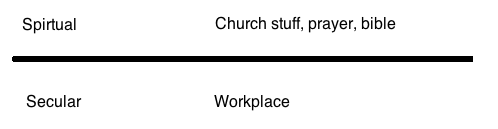


 And as soon as we draw it, we know thats too simple - we should make the line dashed and all that.  We know God is creator, everything is His, etc. In fact, its not a Christian world view at all - its entirely incorrect.  

But nevertheless, in operative terms, i think we often tend to that dualism. We tolerate it and often revert to it.

Here is how the commenter went: Quoted my post  first (italics below). Then commented (in blue).


"In several churches, i've noticed that in addition to the pastoral staff, it is the volunteer group (eg the occasional RE teachers) who are cited- and i think its right that they are supported like this, as they try to get to the point of sharing their faith. But should the complexity and heavy demand of the other roles be invisible - seeing as they are also bringing the redemptive leaven of the kingdom in other ways? Or do they just have a job - a 'secular job' at that? "

This observation is a true one. My belief is though that until others can actually show the vital connections between faith/work as a necessary whole connection with the Gospel, then the current divisions on sacred/secular will remain.

In spite of what you say about the "slipstream of faith" being able to carry one into these connections at your workplace, I think that on the whole they are hard to make and even harder to verbalize within the body times.

I don't think being "transformed by the renewing of your mind" is an automatic thing just by being connected to the engine of faith.
When confronting the existing deep seated cultural 'norms' of our days, I think it biblical to name and confront the 'idols of our times' which infect and drive each cultural sphere and this surely must be done with great prayer, ongoing reflection and consultation within groups of believers who work in similar contexts(ie teachers together, technicians together) together by those listening to what the Spirit says and then finding together strategies with which to respond.
My contention is that this ought to be the focus of body life. This is our spiritual worship as Paul contends.
Our body life would surely explode with excitement and holy awe and fear and rejoicing as we share how God is moving through us to release the creation from its groaning despair. 

I was going to say more, but i can't now recall what it was - but the comments in blue speak to me  - we attended a workshop on theology of work, and i think a vision of naming some of these in the body time could help - not that  i know how it could be done. Simply starting with naming each ones role and work from time to time would help i suppose - ie doing interviews of what people do.

The theology of work website that accompanied the seminar would also be a useful study tool. If i had time i'd like to run a series of studies based on that site. Listen to the president of the project explain it. Not the most photogenic chap, but thats hardly the point!
http://www.theologyofwork.com/pages.asp?pageid=101815

or as Bill Johnson said of work, in a sermon from around that time. :

Work is supposed to be a tool that is used – a musical instrument in a sense, that is used– that we use in giving worship to God. When work is robbed from someone – worship, the tool of worship, is robbed from their life, a unique expression of worship. The whole Jewish culture looked at work, labour, as a way of giving expression of worship to God. And I feel like we’re supposed to rise as church family toward the devourer who would steal the privilege of labour from everyone who is supposed to be able to work. I feel like its supposed matter.


Friday, February 10, 2012

lasers and rainbows - home domain

(i reverted this to a draft for a couple of years, as being a bit unbalanced - happier with it now  - balanced it out a bit more - so my son's example has moved on a bit)

(having previously looked at the basic metaphor of tightly focussed lasers against wider rainbows, this post looks at how some of that plays out in a family life; how tightly is faith conceived around church etc)

my son chooses, for his nightly bed time story; whatever he wants ...superheroes, school readers, maybe a recorded book, and sometimes something from his children's bible

there is faith going on in that child

He was happy to miss church this morning and go sailing  ... yet spontaneously asks as we drive out....do we love God? we do don't we dad?

i know him well enough to sense that this is not any anxiety at missing church  ... don't think we've managed to instill that religiosity in him :)

no, its the same impulse i see in him sometimes when he is touched by the experience of worship; when the music and sense of Gods presence draws him in; a response that is genuine ...and i can see that something of that personal intimacy is occuring as drive out under a sunny sky; the relaxed nature of what we are doing has evidently helped opened things for him, and a touch of God is upon him

back to his night time reading : he has asked for a story of Moses recently; likes the little section titled God's rules....and i quite like how it is done; very simplified for a first grader of course

until we get to the 'follow up questions' which are placed at the end of every little chapter:  
"God spoke to Moses and gave him some special rules" (pictures of Moses on mountain)

"How does he speak to us now?" ... pictures of :
of what.....? what should go in there?

the book has chosen to show bibles and church

(not children driving out to sailing boats under sunny skies, relieved to avoid church for the day...experiencing Gods touch and affirmation as we drive)
no, the creation frame is absent ...no mountains...
and other things are absent ...
evidently Moses experienced God in powerful and unusual ways ...but "how does God speak to us now?"

cue, echoed through all evangelical sunday schools : "through the bible and by going to church"

so the experiential dimension of God is relegated to times past; and the New Testament experience is codified as (a) textual, and (b) church centered

of course there is truth in both - studying the Word and assembling together is significant

but something is lost too

where is the prophet on the mountain experiencing God face to face? - the one God calls a friend - in this version
while we don't need to suggest amazing or primitive personal experiences of God are the rule, neither should we rule it out

I feel part of the church's pact with modernism - we will subscribe to belief in a God who is sufficiently transcendent that we can attribute all sorts of attributes to Him, who is distantly conceived of as Author and Judge, and also ascribe some limited personal private experience; he might stir us with a little encouragement.

In between these two extremes ...distant eminence and muted personal presence, we won't expect too much; not a God who actually turns up in biblical dimension.

we call ourselves biblical by knowing the text; but read through the idea of his distant greatness and his general local mildness; no flames of fire.

ironically, though the reformation restored many of the experiental truths of faith, it lost some as well; although the Catholics still preserved an open-ness to supernatural dimension (mixed with various other strange things i know - but my point is they never ruled out the supermatural the way many Protestants effectively have)

(its helpful to not rule life into spiritual and non spiritual bits in arguing against this omission though - the lived experience of life is a spiritual thing - and God's gentle presence and guidance is more often pressed quietly into our hearts in this way; but if He wishes to rain gold dust, i'd like to be there)

next : part (3) lasers and rainbows in the workplace

Wednesday, November 11, 2009

lasers and rainbows (1)


Why lasers and rainbows?

Since the two represent two styles of church, or perhaps faith.

(nb: I wrote these next 3 posts in 2009, as the first things on the blog, but reverted them to hidden drafts - felt a bit unready. Happier with them now, after a little rework, so unhiding again.  

Having read more since then, i'm also more confident the intuitive metaphor does describe something -  that we could capture some of this along the phrase suggested in the last post - that the gospel of salvation has largely displaced the gospel of the kingdom. That we have taken certain valuable truths (redemption, faith) and emphasised them, perhaps in disproportion to other themes, such as God as Creator of all  (so we're good at explaining conversion; less good at discussing redemptive influence in the the realms of work and culture, for example - but i'm getting ahead of myself).
I listen to various teaching series these days,  and gather there are more scholarly foundations behind these observation than Johnson's apt phrase.  So could also say that certain treasured truths in the reformation tradition, have been celebrated at the exclusion of some of the wider implications of the Kingdom message; even, perhaps, that a distortion of full biblical message can result. There is also truth in the aphorism that the medium is the message. If we're only thinking through the locus of church as the gathered people, we have part of the message - and as crucial and essential as those parts are, there is a wider backdrop as well. 

Anyway, back to the original, more intuitive, take on this. 

lasers : I associate this, quite sympathetically, with many classic pentecostal churches (but i think applies to much of the charismatic and evangelical mix, where i have also spent some years, as well).
The laser is intense, focussed, bright, well defined. It teaches its values with passion; commits its young people to strong programmes of discipleship; induces high levels of commitment. It defines what is right and wrong in pretty clear terms; less so in practice than it might seem in preaching, but the values bus is pretty clearly labelled. The positive experience i have had of this tells me that lasers cut through; life is changed. People are picked out; salvation is real, worship intense.

The range of wavelengths though, is not so broad.

People tend to be drawn to one or two frequencies which dominate; and indeed these cultures tend to ask people to resonate around those frequencies. The power of this is bright, intense pencils of light.
There tend to be supporting systems around this (clear program of services etc) A technical description of creating lasers often uses words like 'pumping' and 'forcing' - and these cultures can sometimes feel a little forced. The culture around this can sometimes try to keep the 'level' there when its not really happening, can be slow to acknowledge the dynamics of seasons and times. 'Did I tell you it was wine, when really it was water?' as one song reflects on this.

(In saying that, though, I want to acknowledge that the focus associated with intensity of God experience can be powerful - and there is enough new wine in the experience that i can understand the tendency to want to stay expectant ... and i think i prefer it to losing the dynamism altogether which is perhaps the other end of that spectrum. )

(The balance here is perhaps to 'earnestly desire' as per the biblical instruction and example but not slip into grounding faith on current experience, or detached from an exploration of other dimensions what it means to be in the kingdom).

Compare all this with Rainbows.

The same energy is here distributed more diffusely. Less burning intensity; but more gentle displays of colour and goodness.

I could associate this with a less intense style of church, but what i really want to link it with is a different perspective on faith. One that is less centered around well defined cultural boundaries; and less inclined to centre itself around a supporting infrastructure of church services. One that is more inclined to see the fullness of what God is doing, in a bigger context; writ across the creation, including the spheres of work and culture; less narrowly defined than the laser, perhaps less intense, yet also wider.

Neither, i would say, is preferable.  Seems a common mistake for churches to settle down in the rhythms of the second, and still hope to reach young people; particularly those newly coming to faith
And equally, those who never move beyond the narrow boundaries that may have accompanied their first ecstatic experience of God; though the experience transformed; may perhaps find a cultural box that seems too restrictive, even oppressive for some.

Both approaches are needed; in balance with whatever calling one has i guess.

Exploring some of the tension between these - and moving from the first to second, is the theme of the next couple of posts; in part 2 there are some practical questions observations of how this plays out in family and default models of faith for children. Part 3 looks at the issue which has been very real for me; how is the world of work conceived and represented and understood in the church.

I suspect it will also lead to broader questions of what church is meant to be; how centralised should it be in conception and structure - probably posts 4 onwards ... but i haven't written them yet :)

2020 OPPORTUNITIES IN THE SHAKING

  2020 OPPORTUNITIES IN THE SHAKING - 4 horsemen  I have the emergency app on my phone. We monitor here and the beach. It must have gone off...